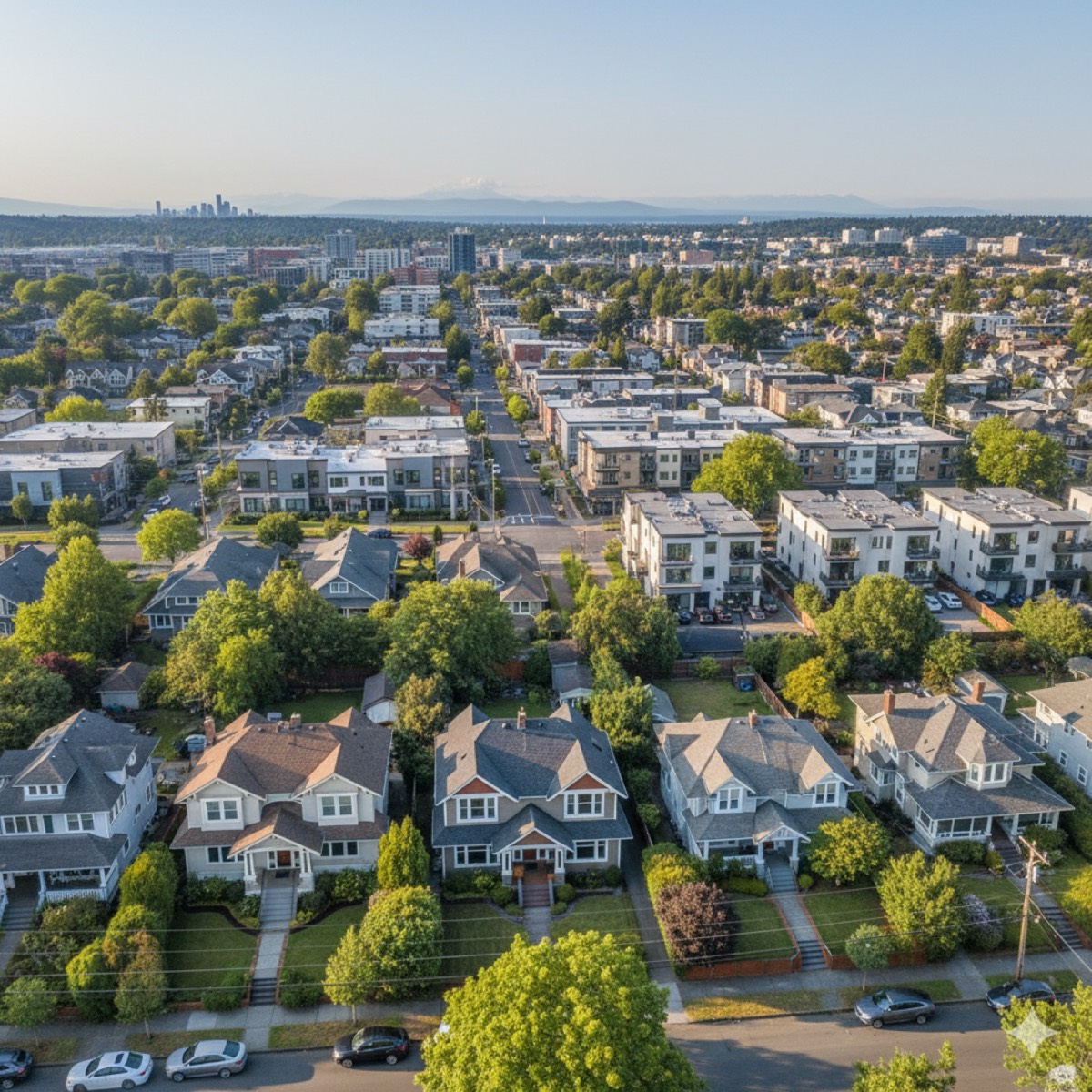
To sell a home in Columbia City, Seattle in a shifting market, price within 1 to 3 percent of recent comparable sales from the last 60 to 90 days, weight the most recent sales heaviest, and adjust for sub-area and condition. Smart pricing draws offers in 13 days or fewer.
That is the headline answer. The rest of this guide walks through how I think about pricing for Columbia City sellers in 2026, what the current market data actually shows, and where I see sellers leave money on the table when they rely on neighborhood averages instead of micro-market comps.
How Is the Columbia City, Seattle Real Estate Market Shifting in 2026?
Columbia City is one of the most active seller markets in South Seattle right now. The headline numbers tell a clear story: the median sale price is about $840,000, year-over-year appreciation runs near 9.5 percent, the median price per square foot is $468 (up 14.7 percent year over year), and the median days on market is 13. Sale-to-list ratios sit above 100 percent, meaning most homes are clearing above their asking price.
What is shifting is not whether Columbia City is a seller's market. It still is. What is shifting is buyer behavior. Buyers are more disciplined than they were two years ago, more inclined to walk if the home is overpriced, and more attentive to condition. A 2024 strategy of listing high and waiting for offers will sit on the market in 2026. A 2026 strategy starts at a defensible comp-based price and lets buyer competition do the work of pushing the final number higher.
For Columbia City sellers, the practical implication is simple. The market is still on your side, but it rewards precision more than ambition.
How to Sell a Home in Columbia City, Seattle: Pricing Step by Step
The pricing process I run for Columbia City sellers follows the same five steps every time. The order matters, because skipping ahead is where mistakes start.
- Pull three to six recent comparable sales from the last 60 to 90 days, within a half-mile of your home, matched on size, style, age, and condition.
- Weight the most recent sales heaviest. In a neighborhood appreciating at 9.5 percent annually, a sale from six months ago is already $40,000 stale on an $840,000 home.
- Adjust for condition and upgrades. Mentally walk through each comp and subtract or add value based on the gap between that home and yours, the kitchen, bathrooms, roof, systems, lot, and view.
- Layer in active and pending listings. Active listings show what your home will compete against the day it goes live. Pending sales show what buyers are willing to commit to right now.
- Set a list price 1 to 3 percent below the strongest comp value. This is the strategic underpricing band that generates multi-offer competition without sacrificing your final sale price.
Sellers who follow this sequence routinely close above asking. Sellers who anchor to a Zestimate or a single high comp routinely close below.
What Recent Comps Tell You About Columbia City Home Prices
The strongest comp meets six conditions. It sold in the last 90 days (60 is better), it sits within a half-mile of your home (and ideally the same sub-area), it falls within 10 to 15 percent of your home's square footage, it matches your property type (single-family, townhome, or condo), it shares comparable age and condition, and the lot size is similar if your home is detached.
From there, focus on four data points per comp:
- Sale price versus list price. A home that sold at 105 percent of list in a bidding war tells a different story than one that sold at 99 percent after three weeks on market.
- Days on market. Fast closings reflect pricing that the market accepted immediately. Slow closings, even with a final price near asking, usually started too high.
- Price per square foot. This normalizes comparison across homes of different sizes. If a 2,200 square foot comp sold at $418 per square foot, that gives you a stronger starting point than the raw sale price.
- Condition and upgrades. A comp with a recent $60,000 kitchen renovation is not really comparable to your unrenovated 1990s kitchen. Adjust the value accordingly before treating that comp as a benchmark.
Which Columbia City Sub-Area Are You Selling In?
Columbia City is not a single market. The historic core along Rainier Avenue S, the Hillman City stretch to the south, and the newer townhome corridors near Rainier Vista all behave differently. A 1920s Craftsman in the Columbia City Landmark District competes for a different buyer than a 2010 townhome two blocks from the light rail station.
Three sub-area dynamics I see most often:
- Historic district Craftsman homes command the highest price per square foot in the neighborhood, driven by buyers who specifically want pre-1940 character and walkability to the Columbia City Farmers Market, La Medusa, and Geraldine's Counter.
- Hillman City single-family homes tend to price slightly below the historic core but appreciate fast, with buyers drawn by relative value and the same light rail access.
- Newer townhomes near the Columbia City Light Rail station price by transit proximity more than by square footage, with the 15-minute commute to downtown Seattle being the headline feature.
Pricing your home accurately starts with knowing which sub-area pool of buyers you are competing for. Using a Hillman City comp to price a historic district home will leave money on the table. Using a historic district comp to price a townhome will sit on the market.
What Are the Most Common Columbia City Pricing Mistakes Sellers Make?
Even in a strong market, sellers leave value on the table. The five mistakes I see most often:
- Using stale comps. In a neighborhood appreciating 9.5 percent a year, a six-month-old sale is already significantly under current value. Always weight the freshest comps heaviest.
- Anchoring to an automated valuation. Zestimates and Redfin Estimates do not know that the comp down the street had a renovated kitchen and yours has 1990s finishes. Automated valuations treat all homes of similar size and age as equivalent, and they are not.
- Comparing across sub-areas. A Craftsman in the historic core and a townhome near light rail may be the same square footage, but they serve different markets at different price points.
- Overweighting a single outlier. One sale at $1.1 million does not make every home worth $1.1 million. Look at the pattern across multiple comps, not the headline number.
- Pricing based on what you need. Your mortgage balance, your next down payment, and your renovation costs do not determine what a buyer will pay. The market does.
Should You Strategically Underprice to Sell Your Columbia City, Seattle Home?
In Columbia City's current market, the answer is usually yes. With inventory tight and median days on market at 13, a list price set 1 to 3 percent below your strongest comp value creates a clear value signal that draws buyer attention in the first weekend. Multiple offers then push the final number above asking. Sale-to-list ratios above 100 percent in the neighborhood are not an accident, they are what disciplined underpricing produces.
The strategy has limits. Underpricing only works in markets with deep buyer demand and constrained inventory, which describes Columbia City today. It does not work in soft markets, and it does not work if the underpricing is so aggressive that it looks like a fire sale. The right band is narrow, and getting it right takes a local read.
Spring 2026 Outlook for Columbia City, Seattle Sellers
Several indicators suggest the spring and summer 2026 selling season will remain strong in Columbia City. Inventory remains constrained at roughly 1.0 to 1.3 months of supply. Buyer demand continues to outpace new listings. And the combination of light rail access, the Columbia City Landmark District character, and proximity to Seward Park's old-growth acreage continues to draw buyers who pay a premium for neighborhood identity.
The neighborhood's Walk Score of 84 consistently shows up in buyer rationale, especially for buyers relocating from less walkable markets. The Columbia City Farmers Market, The Royal Room, Island Soul, and Ark Lodge Cinemas are not just amenities, they are the language buyers use when they describe why they want this neighborhood specifically.
For sellers, the takeaway is simple. The numbers favor you, but smart pricing based on solid comp data is still the difference between a good outcome and a great one.
How a Local Agent Helps You Sell a Home in Columbia City, Seattle
The five-step pricing framework above is not theory. It is the process I run for every Columbia City seller, and the reason I can show clients a defensible list price that sets up multi-offer scenarios on a tight timeline. The work is in the details: which six comps, weighted how, adjusted for what, set against which active listings.
I have lived and worked in South Seattle for more than three decades. Many of my Columbia City clients are repeat clients, and that has taught me that the best outcomes come from doing the unglamorous work upfront, the comp analysis, the staging plan, the marketing prep, before the listing goes live. By the time the home is on the market, the strategy is set and the listing launch can be aggressive.
If you are thinking about selling a Columbia City home in 2026, the best first step is a no-obligation comp review. I will pull the most recent sales for your block and sub-area, walk you through what they tell us, and recommend a list price range based on your specific property. From there, you can decide whether and when to list. Contact me at (206) 854-4468 to schedule a Columbia City comp review.
Frequently Asked Questions
What is the median home price in Columbia City, Seattle in 2026?
The median sale price in Columbia City is approximately $840,000 as of late 2025, with year-over-year appreciation of about 9.5 percent and median price per square foot of $468. Pricing your specific home requires a sub-area comp analysis, not the neighborhood median alone.
How long does it take to sell a home in Columbia City?
The median time from listing to accepted offer in Columbia City is 13 days. Well-priced homes often sell within the first week of going live. Overpriced listings can sit for three weeks or longer before requiring a price reduction.
Should I underprice my Columbia City home to attract more buyers?
Strategic underpricing by 1 to 3 percent of your comp-based value can generate competitive offers and a final sale price above asking. This works best when inventory is constrained and demand is strong, which describes the current Columbia City market. It is a precise strategy, not aggressive discounting.
How many comparable sales should I review before pricing my Columbia City home?
Plan to review three to six recent comparable sales from the last 60 to 90 days within a half-mile radius of your home. Add current active listings and pending sales for a forward-looking view of buyer demand. The strongest pricing decisions come from a tight set of well-matched comps, not a wide net.
Does the Columbia City Light Rail station affect home values?
Yes. Homes within a comfortable walking distance of the Columbia City Light Rail station typically command a measurable premium because of the 15-minute connection to downtown Seattle. Light rail proximity is now one of the most-cited features by buyers in the area.
How does Columbia City compare to other South Seattle neighborhoods for sellers?
Columbia City has stronger appreciation and shorter days on market than several neighboring South Seattle areas, supported by light rail access, the Columbia City Landmark District, and a dense restaurant and arts scene. Sellers benefit from a buyer pool that actively seeks out the neighborhood by name.