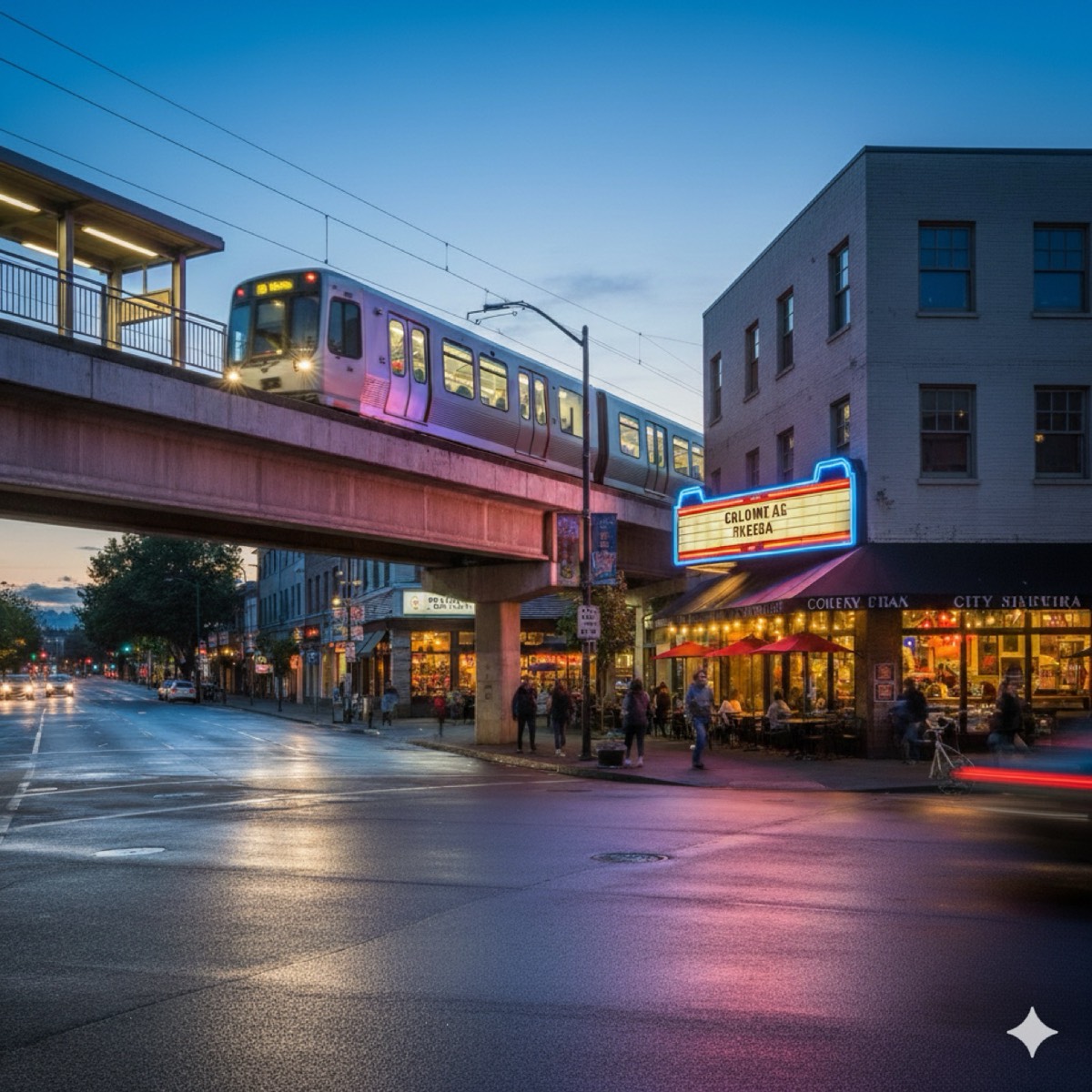
Step off the train at Columbia City Station on a weekday evening and the neighborhood greets you with the smell of jerk chicken from Island Soul drifting across Rainier Avenue South. A few doors down, the neon sign at Columbia City Cinema glows against the darkening sky. Someone with a cello case walks toward the Royal Room, where the night's jazz set starts in an hour. Across the street, the lights are still on at PCC Community Markets, where a line of commuters picks up dinner on the way home.
This is what transit-oriented living actually looks like in Seattle. Not a sterile platform surrounded by parking garages, but a neighborhood with a pulse that you step directly into when the train doors open. Columbia City Seattle homes for sale offer something that very few neighborhoods in the city can match: direct light rail access to downtown and SeaTac Airport combined with a walkable, culturally rich main street and a housing market that, while competitive, remains more accessible than many comparable Seattle neighborhoods.
Columbia City Seattle Homes for Sale and the Light Rail Advantage
Columbia City Station sits on Sound Transit's Link 1 Line. From the platform, downtown Seattle's Pioneer Square Station is about 12 minutes away. Westlake Center, the heart of the downtown retail and office district, is roughly 15 minutes. SeaTac Airport is approximately 25 minutes in the other direction. Trains run every 6 to 8 minutes during peak hours and every 10 to 15 minutes during off-peak times, with service operating nearly 20 hours a day.
For buyers evaluating Columbia City, the light rail connection is not just a convenience. It is a value driver. Research consistently shows that homes within a half-mile of light rail stations appreciate faster than comparable homes outside that radius. In Columbia City, that premium is already reflected in the market data: the neighborhood's median home price of $840,000 has climbed 9.5% year over year, outpacing the citywide average of roughly 4%.
The spring 2026 opening of Sound Transit's 2 Line will add another dimension. Once the Eastside connection is fully operational, Columbia City residents will be able to transfer at the International District/Chinatown Station to reach Bellevue, the Spring District, and eventually Redmond. For buyers who work on the Eastside but want to live in a Seattle neighborhood with genuine walkability and character, this changes the calculus significantly.
Columbia City Quick Facts
The Neighborhood Around the Station
What distinguishes Columbia City from many other light rail neighborhoods is the quality of what surrounds the station. The Columbia City Station sits at the edge of a landmark-protected historic business district along Rainier Avenue South. Within a five-to-ten-minute walk from the platform, you have access to a complete neighborhood main street.
PCC Community Markets anchors the grocery needs. Columbia City Cinema, one of Seattle's last independent neighborhood movie theaters, shows first-run and repertory films in a single-screen setting. Island Soul serves Caribbean cuisine that has drawn diners from across the city since it opened. La Medusa offers Italian fare in a warm, candlelit dining room. The Royal Room hosts live jazz, soul, and world music several nights a week in a space that feels more like a New Orleans listening room than a typical Seattle bar.
This density of walkable amenities is not common in Seattle. Most neighborhoods have a few standout restaurants or a good coffee shop. Columbia City has a full ecosystem of dining, shopping, entertainment, and daily services within walking distance of both the light rail station and the residential streets that surround it. For homebuyers, that walkability translates into daily convenience and long-term property value stability.
Housing Stock and Price Ranges Along the Light Rail Corridor
Columbia City's housing stock is diverse, and prices vary depending on the sub-area and property type.
For buyers specifically prioritizing light rail access, the historic core and Rainier Vista offer the shortest walks to the station. The historic core commands premium prices for its character, walkability, and proximity to the business district. Rainier Vista, a redeveloped community with townhomes and row houses built in the 2000s, provides a more affordable entry point with the same station proximity.
Upper Columbia City, on the hillside west of Rainier Avenue, offers larger lots and territorial views but requires a longer walk or a short bus ride to reach the station. South Columbia City bridges the gap between the core and the Hillman City neighborhood to the south, with a mix of older bungalows and newer townhome construction.
The common thread across all sub-areas is that Columbia City homes move quickly. A median of 13 days on market means that well-priced properties are attracting offers within the first two weeks. Buyers who are pre-approved and prepared to act decisively have a significant advantage.
See what is currently listed in Columbia City: to browse active homes for sale.
Living on the Line: What Daily Life Looks Like
The practical appeal of buying near the Columbia City light rail station extends beyond the commute itself. Residents describe a rhythm of life that light rail access makes possible.
A morning commute might look like this: walk five minutes to the station, board a train, arrive at Westlake Center 15 minutes later, walk to the office. No parking fees, no traffic stress, no searching for a spot. The monthly cost of an ORCA transit pass runs about $100, compared to $250 to $350 per month for downtown parking alone.
An evening might include stepping off the train, picking up groceries at PCC, and walking home in under 10 minutes. On a weekend, the same station provides direct access to Capitol Hill, the University District, and SeaTac Airport without needing a car.
For households that can reduce from two cars to one, the annual savings range from $6,000 to $10,000. Some buyers use those savings to qualify for a slightly higher mortgage, effectively expanding their purchasing power in a neighborhood where every dollar of budget matters.
The lifestyle benefit goes beyond finances. There is a quality-of-life difference between a neighborhood where you need a car for everything and one where you can walk to dinner, groceries, a movie, and a train that connects you to the rest of the region. Columbia City delivers that difference in a way that most Seattle neighborhoods cannot.
Seward Park and Green Space Access
About a mile east of the Columbia City core, Seward Park occupies a 300-acre peninsula jutting into Lake Washington. The park contains one of the last remaining old-growth forests in an urban area in the Pacific Northwest, with a 2.4-mile loop trail, a swimming beach, an Audubon Center, a native plant garden, and an amphitheater that hosts summer concerts.
For Columbia City residents, Seward Park functions as an extension of the neighborhood. Weekend mornings bring runners and walkers to the loop trail, families to the beach, and birdwatchers to the forest interior. The park is accessible by bike, bus, or a short drive, and it provides the kind of large-scale natural amenity that most urban neighborhoods simply do not have.
Closer to home, Genesee Park and Columbia Park offer smaller green spaces for daily use, including playgrounds, sports fields, and picnic areas. The combination of neighborhood-scale parks and a major natural preserve nearby gives Columbia City a green-space profile that competes with neighborhoods costing significantly more.
Investment Considerations for Light Rail Buyers
Buying near a light rail station is both a lifestyle decision and an investment thesis. The evidence supporting transit-oriented real estate is strong. Studies from the American Public Transportation Association and local market data consistently show that proximity to high-frequency transit supports stronger appreciation, lower vacancy rates for rental properties, and more stable demand during market downturns.
In Columbia City specifically, the 9.5% year-over-year appreciation significantly outpaces the citywide average. The 13-day median days on market indicates robust demand. And the expansion of the light rail system, with the 2 Line opening cross-lake service to Bellevue and Redmond, adds a new pool of potential buyers and renters who value the Eastside connection.
For buyers considering Columbia City as a long-term hold, the fundamentals are favorable. The neighborhood's combination of transit access, walkable amenities, cultural diversity, and limited new supply creates conditions that support continued value growth. The homes closest to the station, within a 10-minute walk, are likely to see the strongest appreciation as the transit network expands.
Your Next Step
Columbia City offers a rare combination for Seattle homebuyers: direct light rail access, a walkable neighborhood core with genuine character, and a housing market that, while competitive, provides entry points across a meaningful price range. Whether you are a first-time buyer looking at Rainier Vista townhomes or a family seeking a Craftsman in the historic core, the light rail connection adds value that extends well beyond the daily commute.
The best way to evaluate Columbia City is to visit in person. Ride the train to the station, walk the neighborhood, stop into Island Soul or the Royal Room, and see how the area feels at different times of day. The listings below will show you what is currently available.
Browse Columbia City homes for sale: Contact Eric Uyeji at (206) 854-4468 to schedule a tour.