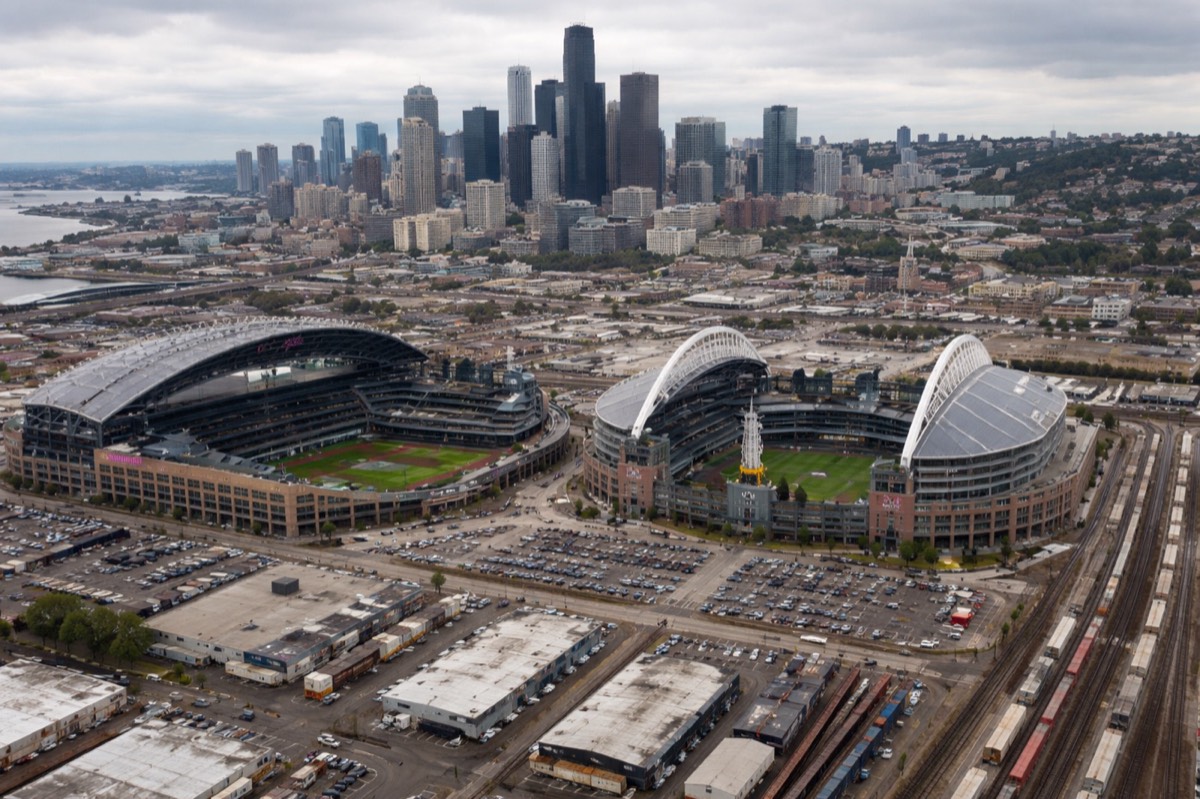
The roar starts about 20 minutes before kickoff. From the rooftop deck of a loft on 1st Avenue South, you can see the glow of Lumen Field's lights against the evening sky and hear 69,000 voices rise in unison as the Seahawks take the field. The street below fills with jerseys and face paint. Food trucks line Occidental Avenue, and the smell of grilled onions mixes with the crisp autumn air. By the fourth quarter, the cheering carries through the open windows.
Three blocks south, the scene is quieter. A couple walks their dog past the darkened warehouses of the tasting room district, closed for the evening but marked by neon signs advertising Patterson Cellars and SODO Urban Works. They turn onto a residential side street where a row of townhomes faces a sliver of the downtown skyline. Inside their unit, the game plays on the television. They could have walked to the stadium in eight minutes but chose to stay home tonight. There will be 120 more event nights this year.
This is what it means to live near the stadium district, and for buyers exploring SODO homes for sale, the proximity to Lumen Field and T-Mobile Park is both the neighborhood's most distinctive feature and its most important variable. This guide explores what stadium-adjacent living actually looks like, where the best pockets of housing are, and how to evaluate whether this location fits your lifestyle.
The Stadium District: What 120 Event Nights Mean for Daily Life
Lumen Field and T-Mobile Park sit at the northern edge of SODO, straddling the boundary between the industrial district and Pioneer Square. Between the Seahawks (10 home games), the Mariners (81 home games), the Sounders (17-20 home games), and a full calendar of concerts and special events, the stadiums produce more than 120 premium event nights per year.
For residents of the surrounding blocks, that activity level creates a rhythm that shapes daily life. On game days and event nights, the area between Royal Brougham Way and Edgar Martinez Drive transforms. Pedestrian traffic surges, restaurants and bars fill up, and parking becomes scarce on public streets. On non-event days, the same blocks are relatively quiet, with the steady hum of industrial activity and the occasional rumble of a freight train.
The experience of living here depends largely on your tolerance for that oscillation. Some residents thrive on the energy. They walk to Mariners games on summer evenings, host friends for Seahawks watch parties on their balconies, and enjoy the fact that their neighborhood is the center of Seattle's sports and entertainment universe. Others prefer to be a few blocks further south, where the event-night energy fades to a background murmur. Both approaches are available within the SODO housing market.
Where to Find SODO Homes for Sale Near the Stadiums
SODO's residential inventory is concentrated in several pockets, each with a different relationship to the stadium district. Understanding these micro-locations helps you choose the right balance of proximity and quiet.
The 1st Avenue South Corridor
Running south from the stadium district, 1st Avenue South is SODO's primary commercial and residential spine. Loft conversions and condo buildings in this corridor sit within a 5 to 15 minute walk of both stadiums. This is the closest residential zone to the action, and it commands a slight premium for that proximity.
The housing here tends toward lofts and condos in converted industrial buildings. Two-bedroom units range from $475,000 to $600,000. The warehouse character of these buildings, with high ceilings, large windows, and exposed structural elements, gives them a distinct aesthetic that appeals to buyers who want something other than a conventional apartment.
The SODO Urban Works Area
Centered around 3931 1st Avenue South, the SODO Urban Works area is the heart of the tasting room district. Ten Washington wine and food artisans share the complex, with communal seating and free parking. Patterson Cellars, one of the state's largest winery tasting rooms, operates nearby. Georgetown Brewing and Machine House Brewery are a short walk south.
Residential options in this area are more limited, but they benefit from the walkable food and beverage scene. Homes here sit roughly 15 to 20 minutes on foot from the stadiums, close enough for easy event access but far enough that game-night noise is reduced to a distant hum.
The Georgetown Border Zone
Where SODO transitions into Georgetown, roughly south of S Lander Street, the housing stock begins to shift from lofts and condos to Craftsman bungalows, mid-century ranches, and newer townhomes. This area offers more traditional residential character while maintaining proximity to both the stadium district (20 to 25 minute walk, 5 minutes by car) and the tasting room corridor.
Prices in this transitional zone range from $450,000 for smaller bungalows to $750,000 for updated Craftsman homes or new-construction townhomes. For buyers who want stadium access without stadium-adjacent intensity, this border zone may be the sweet spot.
Want to explore SODO homes for sale near the stadiums? Browse current listings or call (206) 854-4468 to schedule a neighborhood tour.
The Transit Connection: Light Rail and the Stadium District
The SODO Station on Sound Transit's Link 1 Line sits between the two stadiums and the residential pockets to the south. From the station, downtown Seattle is eight minutes away. Sea-Tac Airport is 30 minutes in the other direction. Stadium Station, one stop north, provides direct access to Lumen Field and T-Mobile Park on event days.
For residents, the light rail serves double duty. On workdays, it is a fast, reliable commute to downtown. On weekends and event nights, it provides an alternative to driving in a neighborhood where parking becomes challenging during games and concerts.
The upcoming Link 2 Line expansion will connect downtown to Bellevue and Redmond via a transfer at the International District/Chinatown station. For buyers who work on the Eastside, SODO's transit access will extend across Lake Washington, making a stadium-district home viable even for an Eastside commuter.
The Short-Term Rental Opportunity
One of the financial advantages of owning near the stadium district is the potential for short-term rental income. With 120-plus event nights annually, demand for short-term lodging in the area is consistent and predictable.
Short-term rental data for the downtown-adjacent and SODO area shows average daily rates between $180 and $220, with occupancy rates of 60 to 70 percent. Average monthly revenue for hosts ranges from $2,500 to $3,500, with game-day and concert weekends commanding the highest premiums.
For owners of two-bedroom or larger units, the math can be compelling. A buyer who lives in the home most of the year but lists it on short-term rental platforms during peak event weekends could generate $5,000 to $10,000 in annual supplemental income, enough to offset a meaningful portion of the mortgage payment.
Seattle's short-term rental regulations require a valid short-term rental operator license and compliance with occupancy and safety standards. It is worth reviewing the current rules before factoring rental income into your purchase decision.
Green Space and Outdoor Access Near the Stadiums
SODO does not fit the typical image of a parks-rich neighborhood, but the outdoor access is better than most people expect. Duwamish Waterway Park, renovated in 2022, sits along the Duwamish River with accessible pathways, a playground with a zipline, interpretive art boulders, a kayak and canoe launch, and open lawn space for community events.
The Duwamish Trail, a multi-use path, connects the area to West Seattle and South Park along the river. The trail provides running, cycling, and walking routes with river views, wildlife habitat, and sightlines to the downtown skyline.
For a larger green space, Jefferson Park on Beacon Hill is a short drive or bike ride to the east. The park covers 52 acres and includes a golf course, sports fields, a skate park, and panoramic views of the Cascades, Olympics, and downtown Seattle.
The outdoor scene here is not defined by manicured gardens or sprawling lawns. It is defined by waterfront trails, industrial-edge parks, and the kind of functional green space that rewards residents who are willing to explore.
Development and the Long View
The stadium district and its surrounding blocks are at the center of SODO's most significant development story. The proposed Makers District would add up to 990 new housing units along First Avenue South and Occidental Avenue, with half designated as affordable at 60 to 90 percent of area median income. The proposal includes subsidized maker and industrial workspaces on lower floors, preserving the creative and manufacturing character of the area.
The project faced a legal setback in November 2025 when the Growth Management Hearings Board sided with the Port of Seattle and BNSF Railway, invalidating the rezoning ordinance. The city has until May 2026 to revise the plan. Housing advocates and city leadership are expected to push forward, but the timeline remains uncertain.
At the broader planning level, the One Seattle Comprehensive Plan, approved in December 2025, identifies SODO as part of the city's strategy for adding housing capacity along transit corridors. Even if the Makers District faces further delays, the policy direction is clear: SODO is part of Seattle's residential future.
For buyers, the development picture suggests a neighborhood whose trajectory is upward over a 5 to 10 year horizon. Purchasing near the stadium district now, before the next wave of residential development changes the supply picture, positions you to benefit from both appreciation and the expanding amenity base that new residents bring.
Finding Your Place in the Stadium District
Living near the stadium district is a lifestyle choice as much as a financial one. It means embracing the energy of 120 event nights while appreciating the quieter rhythm of the neighborhood in between. It means having 70-plus tasting rooms within walking distance and a light rail ride to downtown that takes less time than most people spend looking for parking.
The right SODO home for you depends on your tolerance for game-day energy, your appetite for urban industrial character, and your vision for how you want to live in Seattle. Whether you choose a loft on 1st Avenue South with a view of the stadium lights or a Craftsman bungalow on the Georgetown border where the roar fades to a murmur, the location fundamentals are strong: transit, entertainment, culture, and a price point that still makes ownership realistic.
The stadium lights will keep coming on. The question is whether you will be watching from your own home.
Ready to explore SODO homes for sale near the stadium district? Contact Eric Uyeji at (206) 854-4468 to find the right location for your lifestyle.