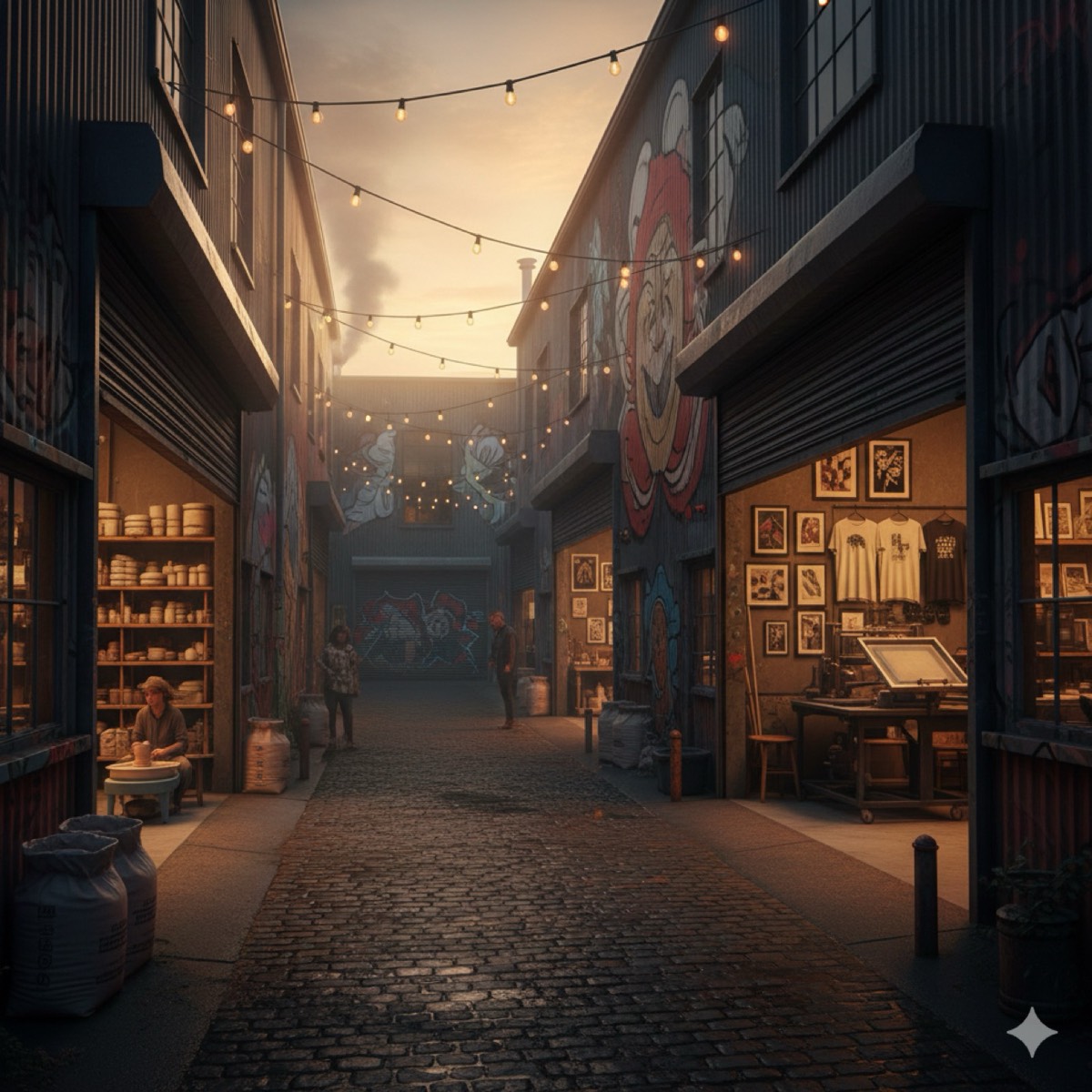
Step into a Georgetown studio on a Saturday afternoon and you will hear it before you see it: the low hum of a pottery wheel, the rhythmic tap of a metalsmith's hammer, the hiss of a screen-printing press pulling ink across fabric. The warehouse door is propped open to let in the breeze. A hand-painted sign reads "Open Studio," and a couple wanders in from the sidewalk, coffee cups in hand from All City Coffee around the corner.
Georgetown Seattle real estate has always attracted people who make things. The neighborhood's industrial bones, its corrugated steel warehouses, its high-ceilinged former machine shops, were built for production. What has changed in recent years is that the people doing the producing are not only renting workspace here. They are buying homes. Artists, woodworkers, ceramicists, brewers, and small-batch food producers are putting down permanent roots in Seattle's oldest neighborhood, and the real estate market is reflecting that shift.
The Creative Infrastructure That Draws Makers to Georgetown
Georgetown's appeal to artists and makers starts with its physical infrastructure. The neighborhood's warehouse stock, much of it built in the early to mid-twentieth century for light industrial use, offers the kind of space that creative professionals need: high ceilings, open floor plans, loading-dock access, and square footage that would cost two or three times as much in Capitol Hill or Ballard.
Many of these warehouses have been subdivided into artist studios, shared workshop spaces, and small-batch production facilities. The rents, while rising, remain lower than comparable creative spaces in other central Seattle neighborhoods. For a sculptor who needs a 1,500-square-foot studio with a freight elevator, or a furniture maker who needs room for a table saw and a spray booth, Georgetown is one of the few neighborhoods in the city where the math still works.
The concentration of creative tenants has a self-reinforcing effect. When enough artists occupy a district, the infrastructure that supports them follows: galleries, supply shops, collaborative exhibition spaces, and the kind of peer networks that make creative work sustainable. Georgetown has reached that critical mass, and the monthly Georgetown Art Attack, where dozens of studios and galleries open their doors to the public on the second Saturday of each month, is the most visible expression of that density.
Georgetown Quick Facts
Why Artists Are Buying Georgetown Seattle Real Estate, Not Just Renting
For decades, the pattern in creative neighborhoods has been predictable: artists move into affordable industrial spaces, the neighborhood gains cultural cachet, rents rise, and the artists are eventually priced out. Georgetown's creative community is acutely aware of that cycle, and a growing number are choosing a different path: purchasing property to secure their place in the neighborhood permanently.
The price points make this feasible. A Craftsman bungalow on a Georgetown side street might list in the $450,000 to $600,000 range, well below the citywide median. Converted loft spaces and newer townhomes offer alternatives at various price points up to about $670,000. For a working artist or maker who has built a viable business, these prices represent a realistic path to ownership in a way that Capitol Hill at $900,000-plus simply does not.
Several Georgetown artists and small business owners have purchased properties that serve a dual purpose: living space above or beside workspace. The neighborhood's industrial zoning and the new Live/Work District rezoning, which allows approximately 900 new residential units with ground-floor commercial or studio space, codifies this pattern into the neighborhood's future development.
The investment logic is straightforward. Artists who buy in Georgetown are not only securing their housing. They are securing their studio. In a city where commercial rents have pushed creative businesses out of neighborhood after neighborhood, owning the space you work in is the ultimate hedge against displacement.
Interested in Georgetown's live/work opportunities? Browse current listings or call (206) 854-4468 to discuss what is available.
The Brewery and Food Scene as Economic Anchor
Georgetown's creative economy extends well beyond visual art. The neighborhood's brewery and food production corridor is one of the densest in the Pacific Northwest, and the businesses anchoring it are not pop-ups or seasonal operations. They are established enterprises with deep roots in the community.
Georgetown Brewing Company is one of Seattle's most respected independent breweries, producing draft-only beers that are distributed throughout the region. Machine House Brewery specializes in British-style cask ales, drawing a dedicated following to its no-frills taproom on Airport Way S. Two Beers Brewing shares a tasting room with Seattle Cider Company, offering a range of craft options in a casual warehouse setting.
On the food side, Fran's Chocolates operates a production facility and cafe in Georgetown, handcrafting the chocolate that has been a Pacific Northwest luxury brand since 1982. The Corson Building, a restored 1910 structure, functions as a farm-to-table event space and restaurant with a national reputation. Jules Maes Saloon, established in 1888, is one of Seattle's oldest continuously operating bars, with an interior that feels like a time capsule of the neighborhood's working-class origins.
These businesses collectively generate foot traffic, attract visitors from across the city, and create the kind of economic activity that supports neighborhood investment. For homebuyers, the brewery and food scene is not just an amenity. It is an economic anchor that stabilizes property values and attracts further development.
The Live/Work Rezoning: Georgetown's Next Chapter
The Georgetown Live/Work District rezoning is the most significant land-use change the neighborhood has seen in decades. Approved by the City of Seattle, the rezoning allows for approximately 900 new residential units in areas that were previously zoned exclusively for industrial use.
What makes this rezoning distinctive is its design intent. Rather than replacing Georgetown's industrial character with conventional apartment buildings, the Live/Work zoning requires ground-floor commercial or studio space in many new developments. The goal is to add housing while preserving the maker economy that defines the neighborhood.
For artists and creative professionals, this is a meaningful distinction. New construction in Georgetown is being designed, at least in part, to accommodate the very community that gives the neighborhood its identity. Live/work units with studio space on the ground floor and living quarters above are the type of housing stock that does not exist in most Seattle neighborhoods at any price.
The timeline for new construction under the rezoning is measured in years, not months. Permitting, financing, and construction cycles mean that the first significant wave of new units is likely three to five years away. For buyers who want to be part of Georgetown before the next phase of development reshapes the market, the current window offers properties at prices that may not be available once new inventory starts to arrive.
The Community Calendar: Art Attack, Honk Fest, and Beyond
Georgetown's community identity is built around events that are genuinely grassroots, not city-sponsored festivals or corporate-branded pop-ups. Georgetown Art Attack, the monthly art walk on the second Saturday, is the anchor event. Dozens of studios, galleries, and businesses open their doors, and the sidewalks fill with foot traffic that moves at a leisurely pace from space to space.
Honk Fest West brings marching bands and brass ensembles to the neighborhood each summer. The Georgetown Carnival, an annual outdoor festival, features live music, local food vendors, and performances that reflect the neighborhood's handmade, slightly irreverent character. The Power Tool Races at the Hazard Factory have become one of Georgetown's most talked-about traditions, combining engineering, spectacle, and the kind of creative risk-taking that you simply will not find in a more polished neighborhood.
These events matter for homebuyers because they reveal the social infrastructure of a community. Georgetown's events are organized by residents, attended by residents, and sustained year after year because the people who live here care about maintaining shared spaces and shared experiences. That is the kind of community investment that does not show up in a listing description but shapes daily life in profound ways.
Who Is Buying in Georgetown Today
The buyer profile in Georgetown has evolved over the past five years. While artists and creative professionals remain a core segment, the neighborhood is also attracting first-time buyers priced out of more expensive central Seattle neighborhoods, remote workers who value character over conventional suburban amenities, and small business owners who want proximity to their workspace.
The common thread is an appreciation for authenticity. Georgetown buyers tend to value exposed brick over granite countertops, neighborhood character over HOA uniformity, and walkable breweries over drive-to shopping centers. They are often willing to accept the trade-offs that come with an industrial neighborhood, some freight noise, limited conventional retail, and a streetscape that is functional rather than manicured, in exchange for affordability, community, and a sense of place.
If that description resonates with you, Georgetown is worth a serious look. If it does not, that is equally useful information. The best neighborhood decisions are the ones grounded in an honest assessment of what you value.
Ready to explore Georgetown Seattle real estate? Contact Eric Uyeji, Managing Broker at John L. Scott Real Estate, at (206) 854-4468 to schedule a neighborhood tour.