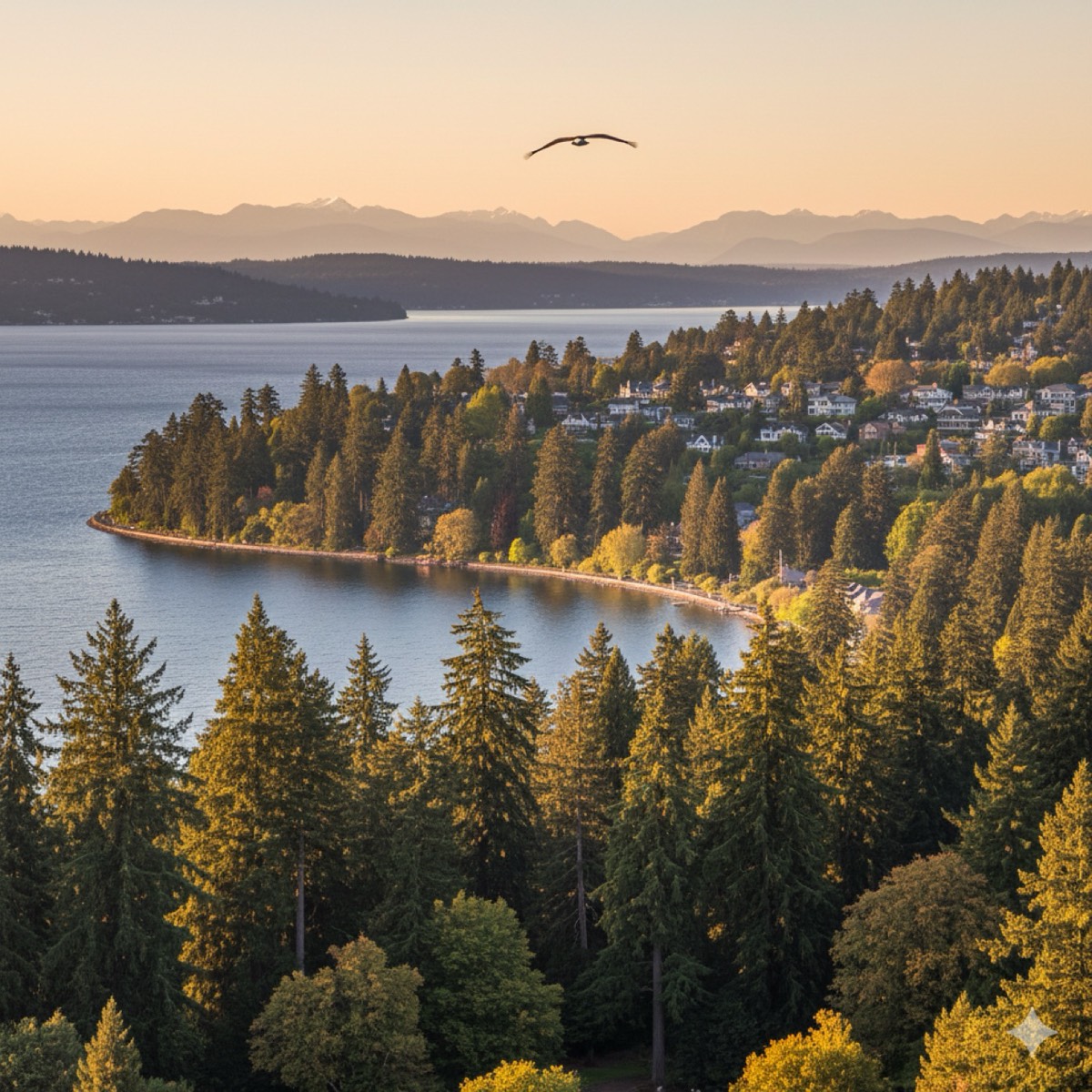
The trail loops through 300 acres of old-growth forest, the canopy dense enough to block out the city entirely. Western red cedars tower overhead, some of them more than 250 years old. A bald eagle circles above the peninsula where Lake Washington bends southward. Joggers pass in both directions on the 2.4-mile loop, and a family sets up picnic blankets near the swimming beach. This is Seward Park, and it sits roughly one mile east of the heart of Columbia City.
For buyers exploring Columbia City Seattle homes for sale, Seward Park is more than a nearby amenity. It is a defining feature of daily life in this neighborhood. The proximity to 300 acres of urban old-growth forest, a public beach, an Audubon Center, and one of the best trail systems in the city sets Columbia City apart from virtually every other Seattle neighborhood in its price range. Buyers who care more about the commute than the trailhead should compare these blocks with our guide to homes on the Link light rail line.
This article explores what it means to live near Seward Park, the housing options available in the surrounding blocks, and the factors that make this pocket of Columbia City one of the most compelling places to buy a home in South Seattle.
Columbia City Seattle Homes for Sale: The Seward Park Corridor
The residential area between Columbia City's commercial core along Rainier Avenue S and Seward Park to the east is one of the quieter, more established pockets of the neighborhood. Streets like S Orcas Street, S Alaska Street, and Wilson Avenue S are lined with mature trees, well-maintained yards, and a mix of housing styles that spans nearly a century.
The homes closest to Seward Park tend to be larger and sit on bigger lots than those in Columbia City's denser core. Many were built in the 1920s through 1950s, with Craftsman bungalows, Tudor revivals, and mid-century ranches making up the majority of the housing stock. Newer infill construction, primarily townhomes, has added inventory in recent years, but the overall character of the Seward Park corridor remains distinctly residential and unhurried.
For buyers, the appeal is straightforward: you get the walkable restaurants, light rail access, and cultural energy of Columbia City's main street, combined with the quiet, green, park-adjacent living that the eastern blocks provide. It is a combination that is genuinely difficult to find elsewhere in Seattle.
Quick Facts: Columbia City Near Seward Park
What the Housing Stock Looks Like East of Rainier
The blocks between Rainier Avenue S and Seward Park offer a range of housing types. Here is a snapshot of what buyers can expect by property type and price range.
The Craftsman bungalows are the most sought-after homes in this corridor. Original Craftsman details, including built-in hutches, box-beam ceilings, and leaded glass windows, are increasingly rare in Seattle's housing stock. Buyers pay a premium for these features, particularly when the homes have been updated with modern kitchens and bathrooms while preserving period character.
Mid-century ranches offer a different value proposition. Their single-story layouts appeal to buyers who prefer one-level living, and their lots are often wider and deeper than what newer construction provides. Many of these homes have not been significantly updated, which creates an opportunity for buyers willing to invest in renovations over time.
Townhomes have filled in gaps where older homes were demolished or where vacant lots became available. They provide the most turnkey option for buyers who want new construction without the price tag of a custom build.
Living Near Seward Park: What Daily Life Looks Like
Seward Park is not a neighborhood park with a playground and a patch of grass. It is a 300-acre old-growth forest preserve on a peninsula extending into Lake Washington. The park includes a 2.4-mile perimeter loop trail, interior forest trails, a swimming beach, a fishing pier, an amphitheater, a pottery studio, and the Seward Park Audubon Center, which offers year-round environmental education programs.
For residents of the surrounding blocks, the park functions as a backyard of extraordinary scale. Morning runners loop the perimeter trail before work. Families spend summer afternoons at the swimming beach. Bird watchers track bald eagles, great blue herons, and pileated woodpeckers through the old-growth canopy. The amphitheater hosts free concerts and community events during the summer months.
The practical benefit is that living near Seward Park means you do not need to drive anywhere for outdoor recreation. A 10-minute walk from most homes in the eastern Columbia City blocks puts you on a trail in a forest that feels hours away from the city.
The Columbia City Main Street: Walkable from Seward Park Corridor Homes
One of the reasons the Seward Park corridor commands strong prices is its proximity to Columbia City's historic business district. Rainier Avenue S between S Alaska Street and S Edmunds Street is one of Seattle's most complete walkable main streets, and most homes in the Seward Park corridor are a 10 to 20 minute walk from its center.
The dining options alone distinguish Columbia City from many Seattle neighborhoods. Island Soul serves Caribbean-inspired fare that draws visitors from across the city. La Medusa offers Italian-influenced seafood in a warm, neighborhood setting. The Royal Room combines a restaurant with a live music venue featuring jazz, soul, and world music. PCC Community Markets provides a full-service grocery option within walking distance.
Columbia City Cinema, one of the last independent single-screen theaters in Seattle, anchors the cultural side of the main street. The Columbia City Farmers Market operates on Wednesdays during the growing season and brings local produce, prepared foods, and live music to the neighborhood.
Interested in exploring Columbia City homes near Seward Park? Browse current listings or call (206) 854-4468 to schedule a tour of the neighborhood.
Transit, Commute, and Connectivity
Columbia City Station on the Link 1 Line sits at the western edge of the neighborhood along Martin Luther King Jr. Way S. From the station, downtown Seattle is approximately 15 minutes away and Sea-Tac Airport is about 20 minutes. Trains run every six to eight minutes during peak hours.
For buyers in the Seward Park corridor, the walk to the light rail station ranges from 15 to 25 minutes depending on your exact location. Some residents bike to the station, which takes about 5 to 10 minutes. Others drive to the station and use the limited nearby street parking.
The practical effect is that Columbia City provides a genuine transit-oriented lifestyle for commuters who work downtown or need regular airport access. The 2 Line expansion, expected to connect downtown to Bellevue and Redmond, will make Columbia City even more attractive to Eastside commuters who want to live in a walkable Seattle neighborhood.
By car, downtown Seattle is approximately 15 to 20 minutes away outside of rush hour. I-90 access is available to the north, connecting to Mercer Island and Bellevue. The Lake Washington Boulevard corridor provides a scenic route north to the Arboretum and the University of Washington.
New Development and Neighborhood Trajectory
Columbia City is growing, but the growth is measured and community-oriented. Two notable development projects are shaping the near-term landscape.
Habitat for Humanity is completing 58 new affordable condominiums, its largest project ever in the neighborhood. The units target families earning below 80% of area median income, with mortgage payments capped at 35% of household income. Completion is expected in spring 2026. This project adds affordable homeownership options without competing with market-rate sales.
The African Community Housing and Development organization is building 8 four-bedroom multigenerational townhomes at MLK Jr. Way S and S. Edmunds Street, within one block of the Columbia City light rail station. These units serve the neighborhood's African immigrant community and add transit-oriented affordable housing.
At the broader policy level, Seattle's One Seattle Comprehensive Plan, effective January 2026, includes increased housing capacity in transit corridors throughout the Rainier Valley. Additional development proposals along the light rail corridor are likely in the coming years, which will continue to add density while supporting the retail and dining scene that makes Columbia City attractive.
Who Should Consider the Seward Park Corridor
The Seward Park corridor within Columbia City appeals to a specific type of buyer. If you value access to nature as a daily necessity rather than an occasional weekend activity, this area delivers at a level that most Seattle neighborhoods cannot match. If you want walkable dining and cultural amenities without living directly on a busy commercial strip, the residential blocks between Rainier Avenue and the park provide that buffer.
Families are particularly well-served here. The combination of Seward Park's outdoor programming, strong nearby schools, the neighborhood's cultural diversity, and the safety of established residential streets creates an environment where children can grow up with both urban access and green space.
Move-up buyers from condos in Capitol Hill, Beacon Hill, or the Central District will find more space, more character, and more outdoor access in the Seward Park corridor. The median price of $840,000 is higher than some South Seattle alternatives, but the value per dollar, measured in square footage, lot size, neighborhood amenities, and park proximity, is difficult to match.
First-time buyers on tighter budgets should look at the southern edge of Columbia City and the Rainier Vista area, where townhomes and smaller homes in the $600,000 to $750,000 range still provide light rail access and Seward Park proximity, just with a slightly longer walk.
Ready to find your home near Seward Park? Contact Eric Uyeji at (206) 854-4468 to begin your search.