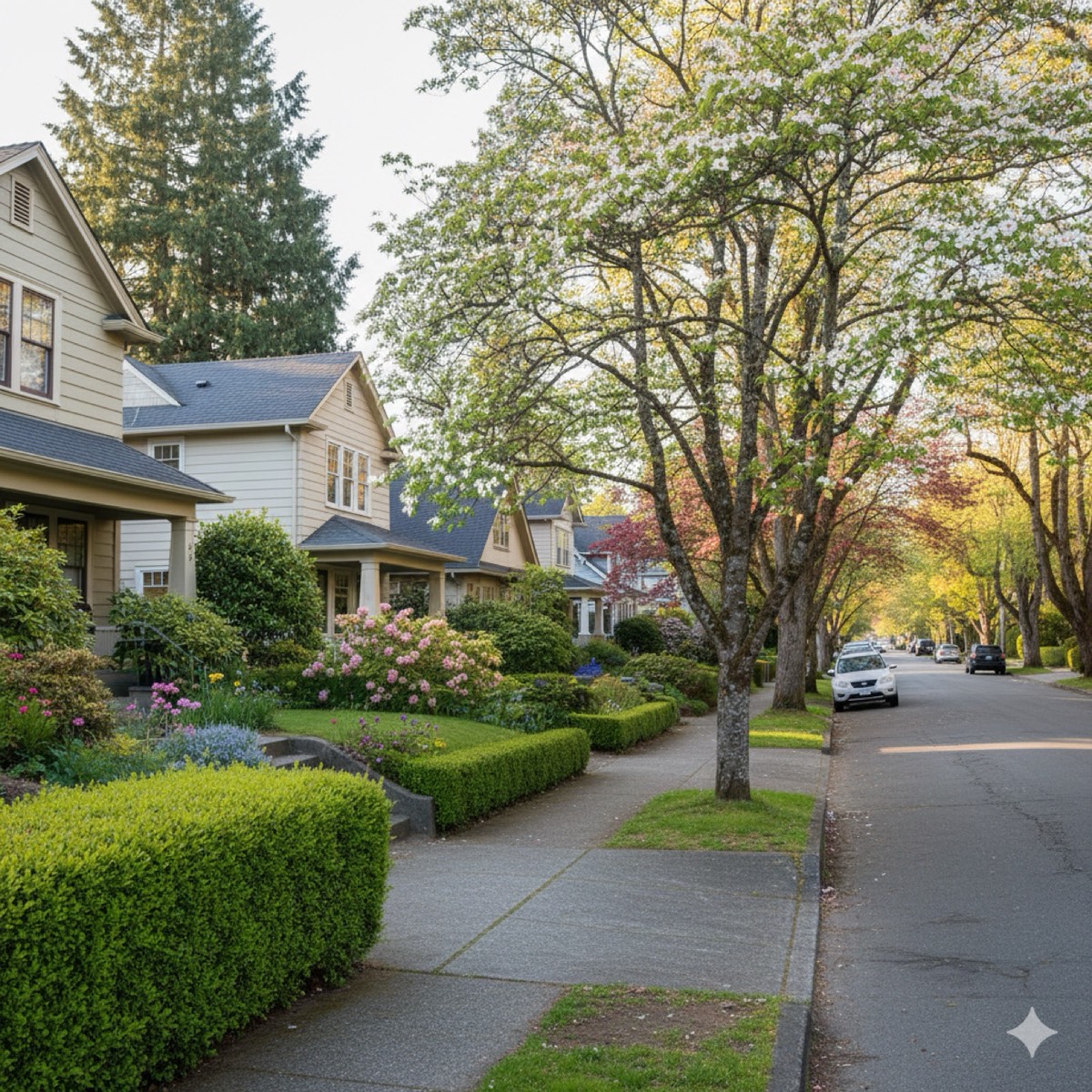
The houses sit back from the sidewalk here, set behind low hedges and established gardens that suggest someone has been tending them for a while. Dogwood branches arch over the parking strip. A tabby cat watches from a porch railing. The street is quiet enough to hear a basketball bouncing in a driveway two houses down, and the air carries the faint sweetness of somebody baking something with cinnamon.
This is Mid-Beacon Hill, the residential heart of one of Seattle's most diverse and underappreciated neighborhoods. It does not have the light rail station that puts North Beacon Hill on the transit maps, and it lacks the redevelopment attention that South Beacon Hill receives through New Holly. What it has instead is something harder to manufacture: a settled, rooted quality that comes from decades of families choosing to stay. For the wider picture of where to eat and gather across the hill, see our Beacon Hill dining and coffee guide.
For buyers exploring Beacon Hill Seattle real estate, Mid-Beacon Hill offers a distinct proposition. The homes are larger, the lots are wider, the prices are lower than the station-adjacent north end, and the neighborhood's character comes not from restaurants and retail corridors but from the people who live on these blocks. This guide covers what you need to know.
Where Mid-Beacon Hill Begins and Ends
Mid-Beacon Hill does not have rigid boundaries, but the area most residents identify by that name runs roughly from S Spokane Street on the north to S Graham Street on the south. Beacon Avenue S serves as the neighborhood's central spine, with residential streets branching east and west.
To the north, the transition into North Beacon Hill is marked by the increasing density of commercial activity along Beacon Avenue and the gravitational pull of the light rail station at S Lander Street. To the south, the neighborhood gradually gives way to South Beacon Hill and the New Holly planned community.
The east-west boundaries are defined by topography as much as anything. Beacon Hill is a long, narrow ridge running north-south, with steep drop-offs to I-5 on the west and the Rainier Valley to the east. Mid-Beacon Hill sits on the crest of that ridge, which means many homes enjoy partial or full views of the Cascades, the Olympics, or the downtown skyline, depending on their orientation and elevation.
Mid-Beacon Hill Quick Facts
Beacon Hill Seattle Real Estate: The Mid-Beacon Hill Housing Stock
The homes in Mid-Beacon Hill reflect the era when they were built. The dominant styles are post-war ramblers and split-levels from the 1940s through the 1960s, with a scattering of earlier Craftsman bungalows and occasional newer infill construction.
Post-war ramblers are the workhorses of the neighborhood. These single-story homes typically offer three bedrooms, one to one-and-a-half bathrooms, and 1,000 to 1,400 square feet on the main level. Many have daylight basements that add another 500 to 800 square feet of finished or semi-finished space, often including a bonus room, a fourth bedroom, and a second bathroom. Original features tend to include hardwood floors under carpet, coved ceilings, and modest but functional kitchens.
Split-level homes, common on the hillside lots, offer a variation on the same era. These typically provide three to four bedrooms across multiple half-levels, with the entry opening to a mid-level landing. They are well suited to the sloped terrain of Beacon Hill and often include views from upper-level rooms that flat-lot homes cannot match.
Craftsman bungalows, while less common in Mid-Beacon Hill than in the north end, do appear. These 1920s and 1930s homes carry the character details that Craftsman buyers seek: built-in bookcases, leaded glass windows, wide front porches, and original millwork.
New construction and major renovations have begun to fill in vacant lots and replace some of the neighborhood's smaller, unrenovated homes. These projects tend to be townhomes or modern-style single-family homes, and they command prices at the upper end of the Mid-Beacon Hill range, typically $800,000 to $950,000.
The Price Advantage of Mid-Beacon Hill
Mid-Beacon Hill's typical price range of $650,000 to $850,000 sits below the North Beacon Hill range of $700,000 to $900,000 and well below the citywide Seattle median of approximately $795,000. The price difference is driven primarily by distance from the light rail station. Homes within a 10-minute walk of the station in North Beacon Hill carry a transit premium that Mid-Beacon Hill properties, located 15 to 25 minutes on foot from the same station, do not fully share.
For buyers who are comfortable with a 5-minute bus ride or a 20-minute walk to reach the station, that price gap represents genuine value. A three-bedroom rambler in Mid-Beacon Hill at $700,000 offers more lot size, more privacy, and often a quieter street than a similarly priced townhome in North Beacon Hill.
The appreciation trajectory also favors buyers who enter at a lower price point. With North Beacon Hill posting 15.6% year-over-year gains, the expectation is that Mid-Beacon Hill will follow as buyers priced out of the station-adjacent area look south along the ridge. This pattern, where appreciation radiates outward from a transit hub, is well documented in Seattle's real estate history.
Want to see what is available in Mid-Beacon Hill right now? Browse current listings to start your search.
Getting Around from Mid-Beacon Hill
Transit access from Mid-Beacon Hill is not as immediate as from the north end, but it remains strong by Seattle standards. The Route 36 bus runs along Beacon Avenue S with frequent service, connecting Mid-Beacon Hill residents to the light rail station in about five minutes and to downtown Seattle in approximately 20 minutes.
For drivers, the neighborhood sits between I-5 to the west and Rainier Avenue S to the east. Access to I-5 northbound and southbound is quick via the S Columbian Way or S Graham Street interchanges. Commute times to downtown run 10 to 15 minutes outside of peak hours.
Cyclists benefit from Beacon Avenue S, which has received protected bike lane improvements, and from the neighborhood's ridge-top position, which makes north-south travel relatively flat. East-west routes involve descending and climbing the hill, which limits casual cycling but provides a workout for those who embrace it.
The practical reality for most Mid-Beacon Hill residents is a mixed transportation approach: bus or light rail for downtown commutes, car for errands and weekend trips, and walking or cycling for neighborhood-level travel. The area is car-convenient without being car-dependent, which is a balance that many Seattle buyers are looking for.
Parks and Green Space
Jefferson Park is Mid-Beacon Hill's signature green space, and it is one of the best public parks in all of South Seattle. The 51.5-acre park sits on the western slope of Beacon Hill and offers panoramic views that stretch from the downtown skyline to Mount Rainier on clear days, with the Olympic Mountains visible to the west.
The park includes a community center, an 18-hole golf course, lawn bowling greens, a skate park, sports fields, a playground, and a splash pad. The Jefferson Park Lawn Bowling Club is one of the few public lawn bowling facilities in Washington State, and the skate park draws visitors from across the city.
The Beacon Food Forest, located adjacent to Jefferson Park, is a 7-acre public food forest that grows fruit trees, berry bushes, herbs, and vegetables for community harvest. It is one of the largest public food forests in the United States and reflects the neighborhood's commitment to shared resources and community-driven projects.
For families, Beacon Hill Playground on 14th Avenue S provides a well-maintained play area within the residential core of Mid-Beacon Hill. The neighborhood's tree canopy is mature, and many streets feel greener and more established than newer developments elsewhere in the city.
Schools and Families in Mid-Beacon Hill
Mid-Beacon Hill is a strong choice for families, and the school options contribute meaningfully to the neighborhood's appeal.
Beacon Hill International School serves grades K-5 and carries a 9/10 GreatSchools rating. The school offers a dual-language immersion program in Mandarin and Spanish, drawing families from across the city. Its location in North Beacon Hill is accessible from Mid-Beacon Hill by a short walk or bus ride.
Mercer International Middle School, serving grades 6-8, continues the international focus with language immersion programs. Cleveland STEM High School, located in Beacon Hill, holds an 8/10 GreatSchools rating and emphasizes science, technology, engineering, and mathematics.
The school profile is a meaningful differentiator for Beacon Hill within South Seattle. Families who prioritize language immersion, STEM education, and diversity find that Beacon Hill's schools align with their values in ways that are difficult to replicate in other neighborhoods at this price point.
The Character of Mid-Beacon Hill
Mid-Beacon Hill is one of Seattle's most diverse neighborhoods. Census data shows Beacon Hill as a whole is approximately 72.5% persons of color, with significant Asian, Black, and Latino communities. That diversity is visible in the small businesses along Beacon Avenue S, in the languages spoken at the parks, and in the food available at local restaurants and grocery stores.
The Beacon Hill commercial corridor along Beacon Avenue S, while centered in the north end, extends its influence into Mid-Beacon Hill through bus access and walkability. Residents of Mid-Beacon Hill regularly travel north along Beacon Avenue for groceries, dining, and services, and the corridor's restaurants reflect the community's demographics: Vietnamese pho shops, Filipino bakeries, Chinese dim sum, and Mexican taquerias share the streetscape with newer additions like Musang and Bar del Corso.
Mid-Beacon Hill itself is quieter and more residential than the north end. The community character comes from block parties, gardening clubs, Little Free Libraries on nearly every block, and the informal relationships that develop when families stay in a neighborhood for decades. It is not a neighborhood that announces itself. It is a neighborhood you discover gradually, and the discovery is part of the appeal.
For buyers who value community stability, cultural diversity, and a residential pace that feels distinct from Seattle's trendier neighborhoods, Mid-Beacon Hill offers something genuine and increasingly rare.
What to Consider Before Buying in Mid-Beacon Hill
Mid-Beacon Hill is an excellent fit for many buyers, but there are trade-offs worth understanding before making an offer.
The distance from the light rail station means transit is not as effortless as in North Beacon Hill. If you rely on light rail daily, the 15-to-25-minute walk may be a consideration, though the Route 36 bus mitigates this effectively.
Many of the homes in Mid-Beacon Hill are post-war construction, meaning they may require updates to kitchens, bathrooms, and systems. Ramblers from the 1950s often have original plumbing, electrical panels that need upgrading, and single-pane windows. These are not deal-breakers, but buyers should budget for renovation costs beyond the purchase price.
The commercial amenities within Mid-Beacon Hill proper are limited. While North Beacon Hill and the Rainier Valley to the east offer groceries, dining, and retail, Mid-Beacon Hill is primarily residential. A car or reliable bus access is helpful for daily errands.
These considerations are part of why Mid-Beacon Hill remains more affordable than its northern neighbor. For buyers who see them as manageable trade-offs rather than obstacles, the value proposition is strong.
Ready to explore Mid-Beacon Hill? Contact Eric Uyeji at (206) 854-4468 to schedule a tour of available homes.